









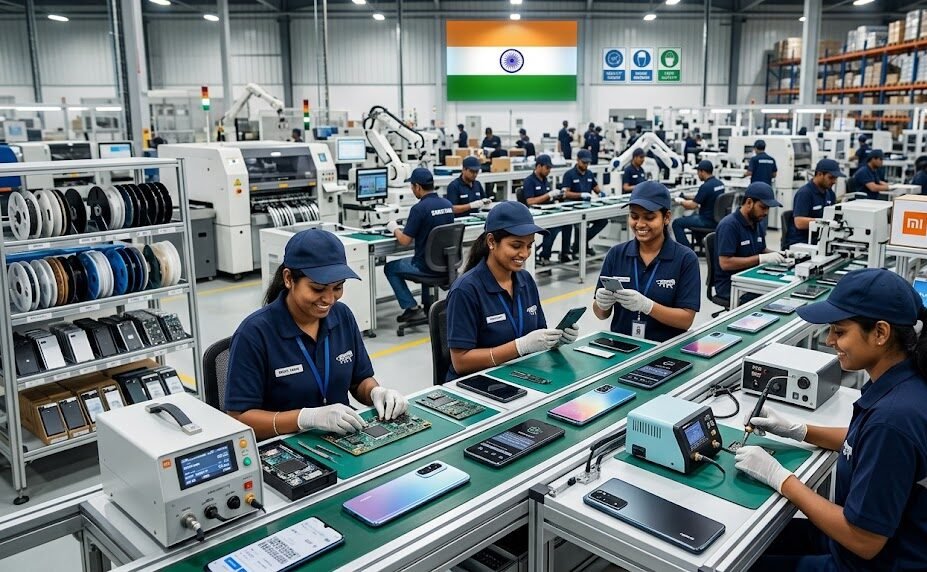
The global supply chain for consumer electronics relied almost entirely on a single manufacturing superpower. Today, that narrative is being dramatically rewritten across the bustling industrial corridors of Tamil Nadu, Karnataka, and Uttar Pradesh. India has officially transformed from a smartphone consumer market into a formidable global manufacturing behemoth.
What began as modest assembly operations has rapidly evolved into high-tech, multi-billion-dollar manufacturing ecosystems. Tech titans and contract assembly giants are moving assembly lines, investing heavily in state-of-the-art infrastructure, and making the country central to their global production networks. The transformation is fast, bold, and fundamentally shaking up world trade.
Walk into any modern electronics manufacturing plant near Chennai or Bengaluru, and you will witness an astounding spectacle of precision automation and human ingenuity. Millions of sleek flagship handhelds roll off modern conveyor belts daily, ready for immediate export to markets across North America, Europe, and the Middle East.
Every economic revolution needs a catalyst, and for India, it came in the form of strategic government initiatives. The ambitious “Make in India” campaign, paired with the game-changing Production-Linked Incentive (PLI) scheme, provided the exact financial leverage global corporations needed to diversify their risk.
By offering targeted financial rewards based on production benchmarks and export performance, the Indian government effectively reduced the entry friction for foreign tech companies. State authorities matched these national policies with streamlined land acquisitions, upgraded infrastructure, and fast-tracked industrial clearances.
The outcome exceeded even the most optimistic early projections. Within a few short years, mobile phone exports skyrocketed from modest numbers into the nation’s top export category. What was once considered an ambitious industrial experiment quickly proved to be a masterclass in modern economic scaling.
The Silicon Titans: Apple, Samsung, and Google Stake Their Claim
When global tech leaders decide to shift their supply chain center of gravity, the rest of the industry takes notice. Apple has led this charge in spectacular fashion, partnering with manufacturing behemoths like Foxconn, Pegatron, and domestic giant Tata Electronics. Today, a significant portion of all iPhones sold globally are assembled directly in Indian facilities.
Not to be outdone, South Korean giant Samsung continues to operate its massive manufacturing mega-facility in Noida, while expanding high-end flagship production locally. Meanwhile, Alphabet’s Google has entered the arena, partnering with local contract partners to manufacture flagship Pixel smartphones on Indian soil.
This migration is no longer just about assembling budget handsets for local buyers. Today, the most sophisticated, high-margin flagship devices are being manufactured and exported straight from Indian factories to global store shelves. It is a decisive vote of confidence in the country’s manufacturing capabilities.
From “Screwdriver Assembly” to Deep Supply Chain Roots
In the early stages of this boom, critics often dismissed the local manufacturing push as mere “screwdriver assembly”—the basic putting together of imported components. However, that phase has quickly given way to a far deeper, localized supply chain matrix.
Global component makers, printed circuit board manufacturers, battery packaging facilities, and display panel assemblers are setting up shop right next door to major assembly hubs. The government’s revamped policy framework actively incentivizes higher local value addition, encouraging companies to source key modules internally.
This clustering effect creates a powerful self-sustaining industrial loop. As local component suppliers proliferate, logistics costs plummet, assembly turnarounds speed up, and the entire manufacturing ecosystem becomes increasingly resilient against global trade disruptions.
Economic Ripple Effects: Jobs, Skills, and Industrial Pride
The macroeconomic impact of this tech surge stretches far beyond corporate balance sheets and export balance charts. The expansion of mobile manufacturing hubs has generated hundreds of thousands of direct industrial jobs, alongside millions of indirect opportunities.
Particularly noteworthy is the transformation of the technical workforce. Tens of thousands of young professionals, including a massive proportion of female workers, are gaining specialized training in advanced robotics, quality control, and precision engineering.
Small towns adjacent to these mega-factories are morphing into vibrant commercial clusters. Improved housing, modern transportation routes, hospitality services, and localized retail ecosystems are springing up naturally, breathing new vitality into regional economies across the country.
Navigating Challenges on the Path to Dominance
Despite the stellar momentum, the road ahead is not without its share of hurdles. Transitioning from component assembly to true semiconductor fabrication and raw material processing requires sustained capital, reliable power grids, and high-efficiency water management networks.
Furthermore, international competition remains fierce, with established manufacturing nations adjusting their own policies to maintain global market share. Indian policymakers and industry leaders must continuously refine infrastructure, streamline logistics bottlenecks, and upgrade labor skillsets to maintain their competitive edge.
Yet, the momentum appears unstoppable. With proposed policy extensions focusing on deep-tech manufacturing, export incentives, and machinery import exemptions, India is signaling loud and clear that its industrial ambitions are long-term.
The New Map of World Technology
The rise of India as a smartphone manufacturing superpower represents one of the most dramatic supply chain reconfigurations in modern economic history. By combining aggressive policy incentives, a vast skilled workforce, and high domestic demand, the nation has carved out a pivotal position in global tech trade.
For global brands, expanding local production in India is no longer just an opportunistic strategy—it is an absolute business imperative for supply chain resilience. The global tech map has officially been redrawn.
As the next generation of mobile devices, artificial intelligence chips, and wearable hardware rolls off Indian production lines, one thing is abundantly clear: the world’s smartphone revolution now runs through the Indian subcontinent.