







Echoes in the Atlas: Discovering Morocco’s Hidden Jewish Heritage
High in the craggy folds of Morocco’s High Atlas Mountains, where terraced fields of barley cling to sheer rock faces, lies the quiet village of Anraz. Down dusty dirt paths and past mud-brick homes, a heavy wooden door opens to reveal an unexpected sight: hand-carved cedar arches, intricate geometric tiles, and Hebrew script glowing softly in the mountain sunlight.
This is Sla d’Anraz, one of Morocco’s many ancient synagogues. Far from the bustling tourist hubs of Marrakech or Fez, these sacred spaces tell a story that spans over two millennia. They offer silent, stunning proof of a deep historical bond between Jewish and Muslim communities across North Africa.
For centuries, Morocco was home to the largest Jewish population in the Arab world, reaching over 250,000 people at its mid-20th-century peak. While the vast majority migrated to Israel, France, and North America decades ago, their physical footprint remains remarkably intact. Hidden throughout remote desert oases, high-altitude Berbers towns, and historic city quarters, these synagogues offer an unforgettable journey into a forgotten past.
To truly understand Morocco’s Jewish heritage, one must look beyond the well-known urban centers. While the Lazama Synagogue in Marrakech and the Aben Danan Synagogue in Fez draw steady crowds, the country’s most captivating treasures are often found where you least expect them. In tiny trade posts along ancient caravan routes, rural Jewish life once flourished alongside indigenous Amazigh (Berber) traditions.
Take the oasis town of Akka, situated on the edge of the Sahara Desert. Here, amidst towering date palms and mud-brick ruins, stands a synagogue that once served desert merchants trading gold, salt, and spices. Restored through recent heritage initiatives, its hand-plastered walls and subterranean rooms reflect a distinct architecture adapted specifically for intense desert heat.
Further west, near the coastal city of Essaouira, the remote village of l’Moul N’Khail shelters the shrine and synagogue of Rabbi Nesim Ben Nesim. Every year, during the pilgrimage season known as Hilloula, hundreds of Jewish travelers from around the globe return to this solitary spot. They gather to light candles, sing ancient Andalusian melodies, and reconnect with their ancestral roots in the Moroccan countryside.
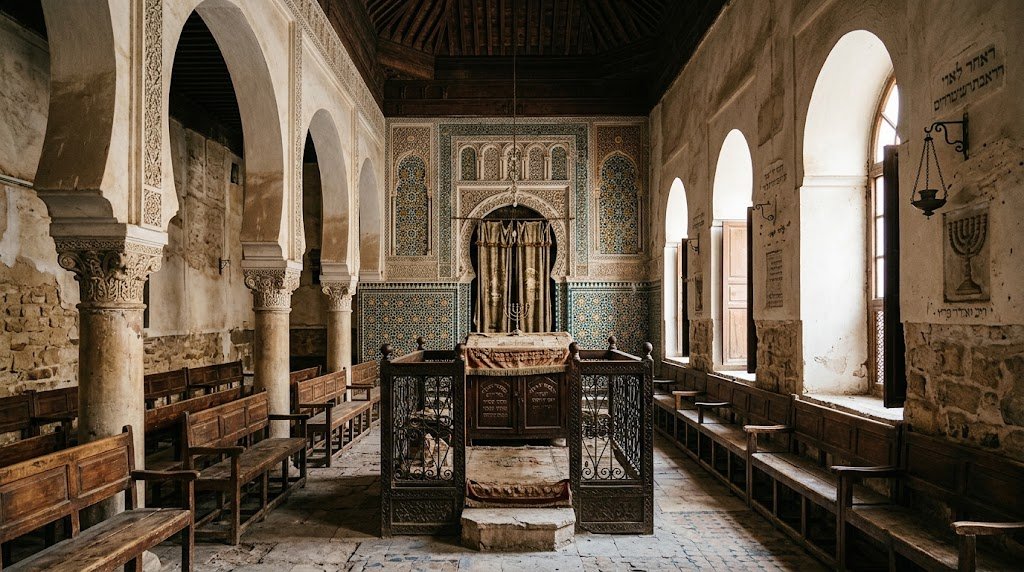
What makes these rural synagogues truly extraordinary is their distinct architectural style. Unlike European synagogues with their grand facades and stained glass, Moroccan synagogues blend seamlessly into their surrounding environments. Built using traditional earthen techniques—pisé (rammed earth) and adobe brick—they reflect local Amazigh building customs while preserving distinct Jewish sacred design.
Inside, the layouts feature traditional layout elements unique to the region. The Bimah (the central raised platform for scripture reading) is often crafted from local cedar wood or forged iron, while hand-painted tiles line the floors. Ornate brass lamp holders hang from ceiling beams, historically used to hold oil lamps that illuminated long night prayers.
The preservation of these sites is a story of communal harmony in itself. In many rural villages where no Jewish residents remain, Muslim neighbors have stepped up as caretakers for generations. These local guardians hold the keys, sweep the courtyards, and welcome curious travelers, preserving the memory of friends and neighbors who moved away decades ago.
In recent years, this preservation effort has gained massive national momentum under the royal patronage of King Mohammed VI. Morocco has launched ambitious restoration programs aimed at safeguarding hundreds of Jewish cultural sites across the country. Synagogues, cemeteries, and historic Jewish quarters (known as Mellahs) are being meticulously restored to their former glory.
This commitment was formally enshrined in Morocco’s 2011 constitution, which uniquely recognizes Hebraic influences as an integral component of the nation’s identity. Today, Morocco stands out in the region as a vibrant crossroad where Jewish history is not just remembered, but actively celebrated as shared national heritage.
For adventurous travelers, exploring these hidden synagogues offers a perspective on North Africa that few mainstream tours provide. Wandering through these serene, mud-brick sanctuaries brings a sense of quiet wonder. Standing in a sunlit courtyard surrounded by centuries of history, you can almost hear the soft cadence of prayers echoing across the mountains.
These sacred spaces serve as a powerful reminder that history is rarely simple, and culture is rarely isolated. The ancient synagogues of Morocco stand as enduring testaments to co-existence, resilience, and art—waiting quietly in unexpected places for those willing to seek them out.