








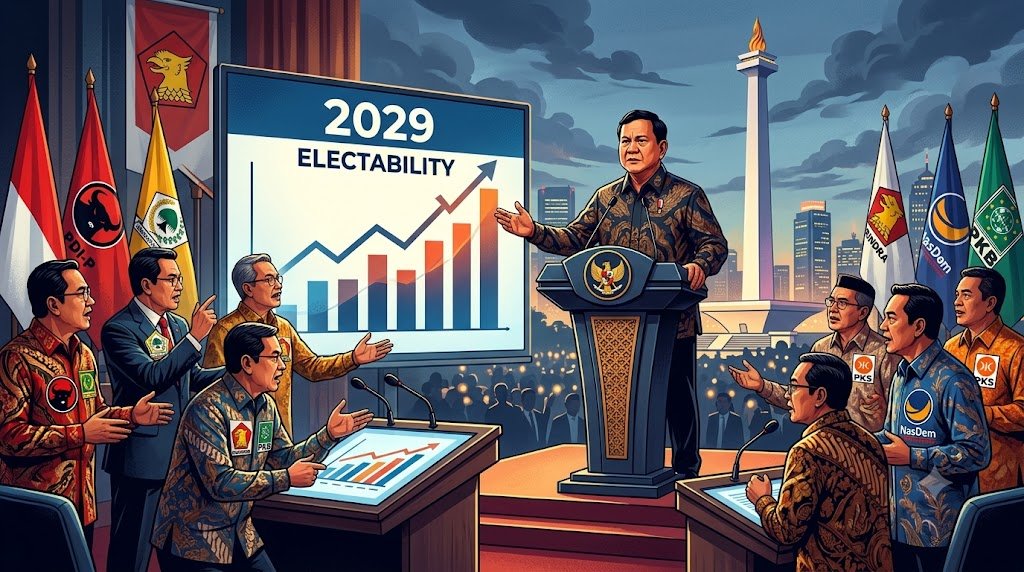
While PAN firmly backs a second term, PDI-P, NasDem, and PKB emphasize that the 2029 presidential race remains three years away, framing the results as performance feedback for the current administration.
JAKARTA – President Prabowo Subianto has emerged at the top of the latest presidential electability survey conducted by Indonesia Political Opinion (IPO), securing 23.4 percent support among potential contenders for the 2029 Presidential Election.
In an open-simulation survey where respondents answered freely without pre-selected options, the Gerindra Party general chairman held the lead over other prominent figures, though researchers noted the margin remains relatively slim.
“In an open simulation where respondents answer without intervention, President Prabowo Subianto’s name remains at the top, although his lead over other names is not yet significant,” said IPO Executive Director Dedi Kurnia Syah in his official statement on Sunday (Aug 9, 2026).
Political Parties Offer Mixed Reactions
Responding to the survey findings, Indonesian Democratic Party of Struggle (PDI-P) Central Executive Board Chairman Andreas Hugo Pareira reminded the public that the 2029 Presidential Election is still three years away. He stressed that survey numbers merely reflect a temporary snapshot of public sentiment.
“Surveys are just a picture of today; the presidential election is still three years away,” Andreas told HALOSUMUT.COM. He added that only Prabowo himself knows whether he intends to run again, stating, “Regarding whether to continue or not, Mr. Prabowo knows best. I cannot predict political outcomes—predicting politics is the realm of analysts.”
Meanwhile, NasDem Party Secretary-General Hermawi Taslim considered it natural for President Prabowo to hold the top spot given his status as the sitting incumbent head of state.
“A survey is a temporary snapshot. It is completely natural for Prabowo to rank highest because he is currently the incumbent in power,” Hermawi remarked. However, he noted that Prabowo appears focused on completing his first-term agenda and recalled Prabowo’s earlier stance that he would only decide on a second-term bid toward the end of his tenure. “So let us wait until the end of Term 1 and see whether Prabowo runs again or not.”
From the National Awakening Party (PKB), Central Executive Board Chairman Daniel Johan framed the survey results as valuable constructive feedback for the government.
“The survey results can serve as valuable input to further strengthen government performance,” Daniel stated. He emphasized that the administration’s primary focus should remain on executing key economic and social programs, adding, “It must yield a significant impact on improving public welfare, absorbing labor, moving the real economic sector, and strengthening farmers and the agricultural sector.”
Conversely, the National Mandate Party (PAN) expressed firm support for Prabowo to contest the 2029 election again. PAN Vice Chairman Saleh Daulay Partaonan asserted that continuity is essential to fulfilling major long-term national initiatives.
“PAN strongly agrees if Prabowo continues for a second term. The projects currently planned and underway are substantial and cannot be realized all at once. Time is needed to bring them to fruition,” Saleh stated, adding that Prabowo’s electability still has significant room to grow.
Top Contenders and Survey Breakdown
Despite occupying the top position, IPO Executive Director Dedi Kurnia Syah highlighted that Prabowo’s leadership in the polls is not entirely secure. The survey revealed a narrow gap between Prabowo and the Governor of West Java, who polled closely behind at 21.7 percent.
Former Jakarta Governor Anies Baswedan secured third position with 11.5 percent, followed by Democratic Party Chairman Agus Harimurti Yudhoyono (4.5 percent), former Central Java Governor Ganjar Pranowo (4.1 percent), and Vice President Gibran Rakabuming Raka at 3.9 percent.
Other national figures registered below three percent, including Sherly Tjoanda (2.1%), Mahfud MD (1.7%), Purbaya Yudhi Sadewa (1.5%), Muhaimin Iskandar (1.2%), and Zulkifli Hasan (1.0%). Meanwhile, approximately 17 percent of respondents remained undecided or opted to keep their choices confidential.
The nationwide IPO survey was conducted between July 27 and August 3, 2026, sampling 1,200 respondents through a multistage random sampling method. The survey maintains a 95 percent confidence level with a margin of error of approximately ±2.9 percent.
Prabowo’s Self-Imposed Performance Benchmark
The latest poll results align with President Prabowo’s previous statements regarding his political future. Speaking at the 6th Democratic Party Congress in 2025, Prabowo asserted that he would refrain from seeking a second term if he felt dissatisfied with his administration’s achievements by his fourth year in office.
“My party cadres nominated me to run again in 2029—they are quite eager. We had only completed 100 days in office, and they were already asking me to run again,” Prabowo said at the time. “But I said, if in my fourth year of service I am disappointed with my own performance, I will not run in 2029.”
Dedi Kurnia Syah underscored that public trust will hinge primarily on tangible policy outcomes. “Public memory must be maintained through policies that align closely with public needs. If the President’s programs are well received, it will provide strong momentum for Prabowo to win a second term.”
As the Prabowo administration progresses through its initial years, public evaluations are increasingly tied to flagship policy implementations, including the nationwide Free Nutritious Meal (MBG) program, strategic food security initiatives, and structural economic reforms.
Political analysts note that the dynamic between the ruling Red and White Cabinet (Kabinet Merah Putih) and parliamentary coalition parties will remain pivotal in shaping the political landscape leading into 2029. While coalition members like PAN and Gerindra favor policy continuity, non-aligned and opposition parties continue to advocate for rigorous oversight on economic metrics, purchasing power, and job creation.
Furthermore, with high voter mobility and shifting demographic trends among young voters—who constitute a majority of Indonesia’s electorate—early electoral surveys serve as a critical barometer for political parties to calibrate their strategies, policy messaging, and prospective alliance structures well ahead of the 2029 general election cycle.