








When you imagine wind power, your mind likely paints a vivid picture of massive white steel towers standing tall on grassy hills or floating off foggy coasts. Those iconic giant windmills have defined green energy for decades, capturing breezes and turning them into clean electricity for thousands of homes.
However, a radical technological revolution is brewing far above the reach of those static steel giants. Engineers across Europe and North America are taking wind power into the upper atmosphere through a cutting-edge concept known as Airborne Wind Energy (AWE).
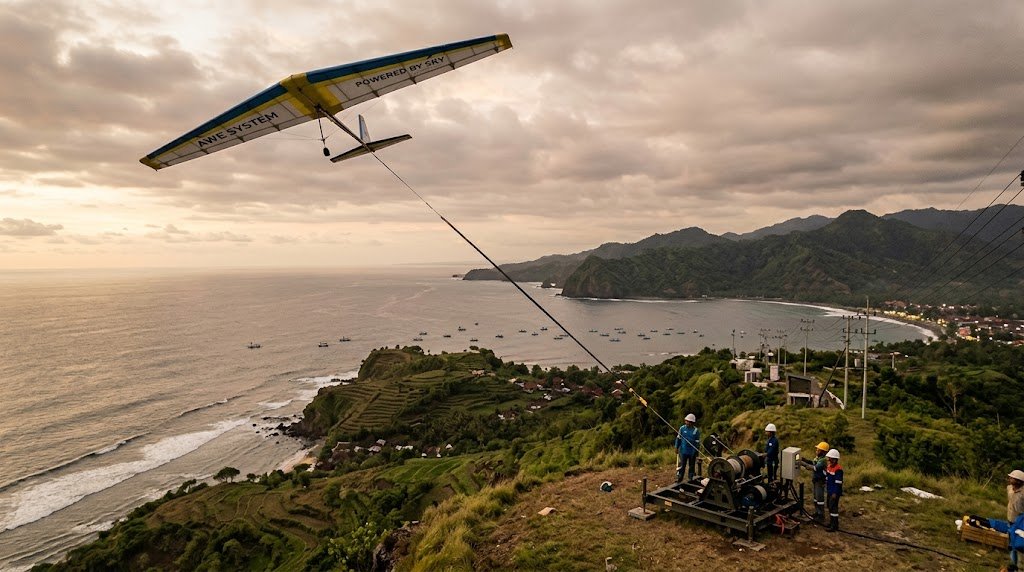
Instead of relying on rigid, expensive towers, AWE systems deploy autonomous tethered kites or drone-like gliders that swoop through high-altitude winds. Up at 300 to 500 meters, atmospheric breezes blow with vastly higher intensity and relentless consistency compared to ground-level winds.
The mechanics behind these high-flying power generators are as brilliant as they are surprisingly simple. As the autonomous kite loops across the sky, it pulls high-tension cables anchored to a ground generator, spinning a turbine that outputs continuous electrical power.
Once the tether reaches maximum length, the system automatically maneuvers the kite to glide back down with minimal drag before launching into another high-tension cycle. Other advanced designs even mount miniature high-tech turbines directly on the flying wing, beaming power straight down the cable in real time.
The economic and ecological advantages of this atmospheric approach are genuinely staggering. Traditional wind turbines require hundreds of tons of concrete foundations and massive steel columns, making them carbon-intensive to manufacture and notoriously difficult to transport across rugged terrain.
Airborne systems, by contrast, eliminate up to 90% of the materials needed for conventional wind installations. The entire ground setup fits neatly inside standard shipping containers, making deployment effortless in remote islands, mountain passes, or disaster-stricken communities.
Despite this breathtaking potential, Airborne Wind Energy remains entirely unrealized across the Indonesian archipelago. While small solar arrays and conventional hydro projects slowly expand across the nation, high-altitude wind harvesters have yet to make an official appearance on local power grids.
That structural delay is a massive missed opportunity for a tropical island nation defined by complex geography. Indonesia features over 17,000 islands scattered across vast maritime territories, where building traditional concrete-and-steel infrastructure often proves logistically impossible or financially prohibitive.
Imagine remote coastal communities in East Nusa Tenggara or isolated villages in Maluku deploying light containerized AWE units in just a few hours. These autonomous flying generators could instantly deliver stable electricity without waiting years for heavy grid expansion or deep-sea cable laying.
Why hasn’t this elevated green technology taken off locally? The delay stems primarily from regulatory caution and grid integration hurdles, alongside an energy policy that still leans heavily on fossil infrastructure and traditional solar projects.
Furthermore, operating autonomous flying wings requires precise air-traffic coordination protocols with aviation authorities. National airspace management frameworks must adapt to allow tethered drones to continuously loop without endangering low-altitude flight corridors or local maritime traffic.
Fortunately, global field trials are rapidly proving that AWE systems are reliable, safe, and ready for commercial scaling. Leading tech startups across Germany, the Netherlands, and the United States are already running long-term grid-connected pilot projects with impressive performance metrics.
As global manufacturing costs drop and operational software grows smarter, Indonesia stands at a critical crossroads. Early adoption of high-altitude wind tech could allow the nation to leapfrog conventional infrastructure completely, bypassing the massive capital expenditure of traditional wind farms.
The winds sweeping high above the Indonesian archipelago carry virtually endless clean energy waiting to be harvested. All it takes is the vision to look beyond traditional ground-bound turbines and finally reach for the skies.