








If you take a wrong turn down a narrow alley in Patan or Bhaktapur, do not panic—you might have just stumbled into the highlight of your trip. Tucked behind humble brick facades and low wooden doorways, hundreds of centuries-old courtyards burst into sudden, vibrant life. Golden stupas shimmer in the afternoon sun, children play tag around sacred shrines, and elderly locals sit on elevated wooden platforms sharing stories over warm cups of chai.
In many historic capitals around the globe, ancient monuments are strictly locked behind velvet ropes and pristine display glass. Nepal’s urban centers in the Kathmandu Valley, however, operate on a completely different architectural blueprint. Here, multi-tiered temples and ancient royal quads are not static relics of a forgotten era; they are the pulsating heartbeat of daily 21st-century neighborhood existence.
This extraordinary living heritage owes its survival to a unique architectural layout known locally as the baha, bahi, or chowk. Developed over a thousand years ago by the indigenous Newar master craftspeople, these interconnected courtyards form the structural and social skeleton of ancient Nepalese cities. Today, these historic spaces continue to thrive, proving that ancient wisdom can effortlessly coexist with modern urban hustle.
The Genius of the Newar Courtyard
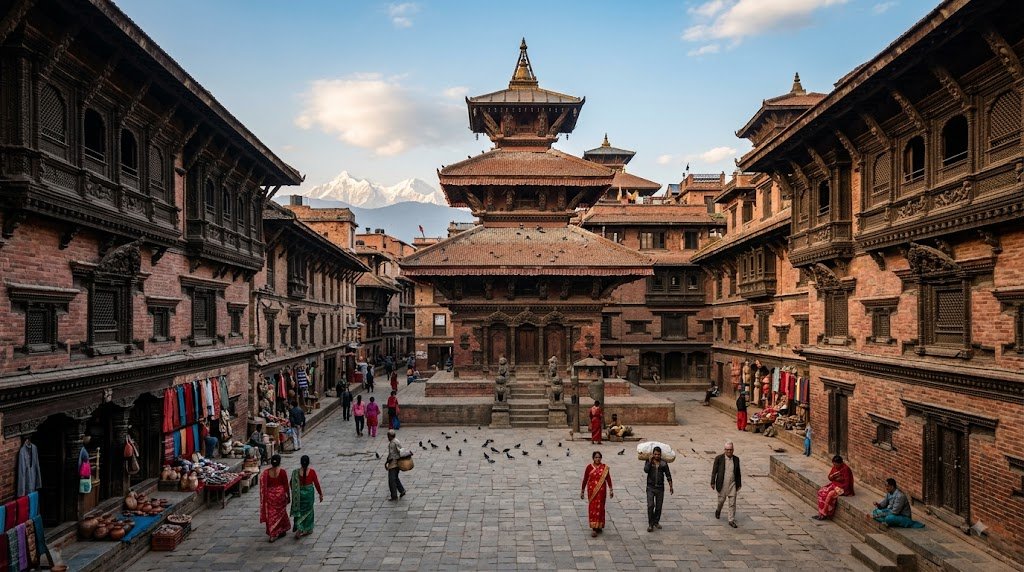
To understand the magic of these urban spaces, one must look closely at how a traditional Newar courtyard is constructed. Framed by three- to four-story red brick buildings decorated with hand-carved lattice windows, each courtyard forms an enclosed sanctuary protected from noisy city streets. The ground is paved with sun-baked terracotta bricks, while the center typically houses a sacred Buddhist chaitya or a Hindu shrine.
These courtyards were originally designed as micro-cities intended to foster profound community bonds. Families from the same extended kinship group have resided around these shared quads for generations, using the open floor for everything from drying chili peppers to celebrating grand wedding rites. It is an ingenious architectural blend of private domestic living and shared public harmony that modern urban planners envy.
Across Kathmandu, Patan (Lalitpur), and Bhaktapur, there are over 300 registered historic courtyards hidden within urban labyrinths. Famous royal sites like Patan’s Mul Chowk and Sundari Chowk showcase regal elegance with gilded brass statues and intricate stone carvings. Meanwhile, cozy residential courtyards like Itum Bahal function quietly as bustling neighborhood sanctuaries where monastic traditions and daily grocery runs happen side by side.
Living Heritage Over Museum Static
What captivates travelers and architects alike is that these historic spaces refuse to become mere tourist props. Walk into a court at sunrise, and you will see local residents lighting butter lamps and offering fresh flower petals to carved stone deities. By midday, yellow grain is spread across large woven mats to dry under the high sun while artisans carve wooden window struts nearby.
As evening approaches, the courtyards transform into cozy community living rooms where generations gather to unwind and chat. Toddlers learn to ride their bicycles around stone statues that were sculpted during the Malla Dynasty in the 17th century. This seamless integration of sacred heritage into ordinary daily routines gives Nepal’s historic cities an authentic, timeless energy found almost nowhere else on Earth.
The architecture itself acts as a natural air conditioner and sound buffer against the chaotic modern traffic outside. Thick brick walls block street noise, while the shaded open quad creates pleasant cross-ventilation during hot summer months. It represents sustainable architectural design at its finest, created long before modern green building standards were ever written.
Earthquake Resilience and Cultural Revival
The durability of these historic courtyards faced a severe real-world test during the catastrophic 7.8-magnitude earthquake in 2015. While numerous historic brick structures suffered severe damage, the flexible timber framing and interconnected quad structures prevented total collapse across many complexes. Crucially, the open courtyard areas immediately served as life-saving emergency shelters for thousands of displaced residents.
In the years following the disaster, an inspiring community-led restoration movement swept through the Kathmandu Valley. Local artisan guilds joined forces with heritage conservation experts to rebuild damaged temples and courtyard facades brick by brick. Rather than replacing wooden beams with modern concrete, woodcarvers meticulously recreated lost patterns using original traditional techniques.
Youth volunteers learned ancient stone-laying and brick-making skills alongside master craftsmen during these reconstruction projects. This intergenerational effort effectively sparked a vibrant renaissance of traditional arts that had been slowly fading in the digital age. Rebuilding the courtyards became a powerful project about restoring living cultural identity rather than just repairing masonry.
Courtyard Cities in the Digital Era
Today, these ancient courtyards are discovering creative, sustainable ways to thrive in the modern global economy. Historic brick homes surrounding the quads are being sensitively repurposed into boutique bed-and-breakfasts, cozy artisan cafes, and independent art galleries. Digital nomads now sip Himalayan coffee while typing on laptops right beside carved peacock windows that date back four hundred years.
This thoughtful adaptive reuse provides vital economic income for local families without destroying the architectural soul of the historic neighborhoods. Visitors are welcomed warmly into the everyday rhythms of neighborhood life rather than being treated as mere observers. You can wake up to the gentle chime of morning temple bells, enjoy fresh sel roti pastries, and step directly out into a World Heritage living sanctuary.
As rapid urbanization continues to transform cities across Asia into uniform glass-and-steel landscapes, Nepal’s courtyard cities offer a brilliant alternative path forward. They prove that true heritage preservation is not about freezing a city in the past like an artifact behind glass. Instead, it is about building human-centered spaces where history, community, and modern daily life can continuously dance together in harmony.