








Imagine an airborne agricultural fleet operating high above the mist-shrouded canopies of Southeast Asia. They do not use tractors, irrigation systems, or GPS-guided drones, yet they plant thousands of native trees every single day with astonishing precision.
Meet the hornbills of Borneo, the iconic feathered heavyweights whose appetite for tropical fruit keeps one of the world’s oldest rainforests alive and thriving.
For millions of years, the dense, multi-layered jungle of Borneo has relied on a delicate ecological machinery to maintain its breathtaking biological diversity. At the absolute center of this machinery is the hornbill family—a group of birds whose striking, helmeted beaks and massive wingspans make them look like creatures straight out of a prehistoric legend.
But far from being mere jungle ornaments, these remarkable birds are the master architects of forest regeneration.
As deforestation and habitat fragmentation continue to pressure ancient ecosystems, scientists are taking a closer look at the indispensable services these birds provide. Without the daily flights of Borneo’s hornbills, the intricate web of plant and animal life across the island would face a silent, slow-motion collapse that no human reforestation project could ever truly fix.
       _____
      /     \       Hornbill Flight Path
     |  (o)  |=========> Drops seeds miles away
      \_____/           Replants native canopy trees
      /     \
The High-Flying Architects of the Ancient Canopy
Borneo is home to eight distinct species of hornbills, including the majestic Rhinoceros Hornbill and the critically endangered Helmeted Hornbill. Each species occupies a specific niche within the towering tropical rainforest, ranging from the lower forest understory all the way to the sun-drenched emergent layer over 200 feet above the ground.
What sets hornbills apart from almost every other creature in the forest is their incredible mobility and size. These birds travel vast distances across rugged terrain every single day in search of fruiting trees. As they journey across hundreds of square kilometers, they connect isolated pockets of woodland that would otherwise remain completely disconnected from one another.
When a hornbill swoops across a broken forest gap, it carries more than just its own weight. It transports the genetic future of the rainforest in its stomach, ensuring that plant populations remain healthy, diverse, and resilient against disease and changing environmental conditions.
Heavyweights with a Delicate Touch: How Seed Dispersal Works
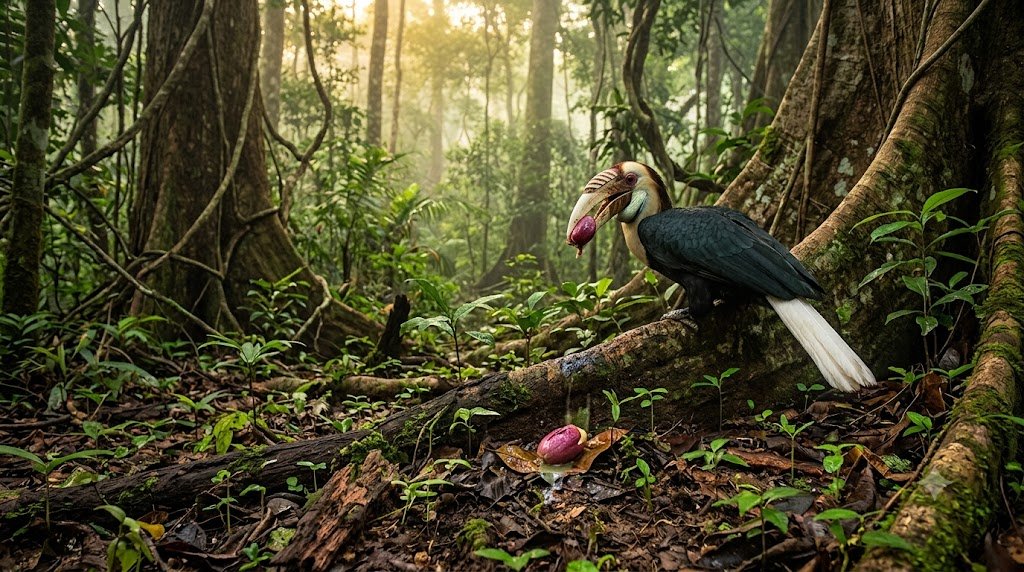
The relationship between hornbills and Borneo’s fruiting trees, particularly giant fig trees, is a masterclass in co-evolution. Many large-seeded rainforest trees produce fruits that are simply too large for smaller birds, bats, or rodents to swallow or carry away. Hornbills possess exceptionally large gape sizes, allowing them to gulp down massive fruits whole without damaging the internal seeds.
Unlike many animals whose digestive enzymes crush or dissolve seeds, a hornbill’s digestive system is remarkably gentle. Seeds pass through their digestive tracts completely intact, or are regurgitated unharmed miles away from the parent tree. This process, known to botanists as endozoochory, gives seeds the absolute best chance at survival.
+------------------+     +-------------------+     +--------------------+
|  Hornbill eats   | --> |  Flies miles across| --> |  Deposits intact   |
|  large tree fruit|     |  forest canopy    |     |  seed with fertilizer|
+------------------+     +-------------------+     +--------------------+
Parent trees naturally attract seed predators and pathogens near their trunks, making it nearly impossible for dropped seeds to sprout underneath the mother tree. By carrying seeds far beyond this “danger zone,” hornbills deposit future trees into nutrient-rich drop zones, complete with a tiny dollop of natural fertilizer to kickstart germination.
Why Human Technology Cannot Replace Hornbill Flight
Over the past decade, conservation groups have spent millions of dollars testing artificial reforestation techniques, including seed-dropping drones and manual sapling planting. While these efforts are valuable, they pale in comparison to the natural efficiency of a healthy hornbill population moving freely across the landscape.
A single hornbill can disperse tens of thousands of viable seeds every year across terrain that is completely inaccessible to human planting crews. Furthermore, hornbills naturally select a balanced, highly diverse diet of various fruit species throughout the seasons, promoting a rich mix of tree species rather than monoculture growth.
By naturally maintaining canopy complexity, hornbills secure habitats for thousands of other species, including orangutans, cloud leopards, tree frogs, and countless rare insects. In ecological terms, hornbills are classic “keystone species”—remove them from the equation, and the entire structural stability of the ecosystem begins to crumble.
Keystone Species in Peril: Threats from the Ground Up
Despite their undeniable importance to forest health, Borneo’s hornbills face severe survival challenges. Poaching remains a devastating threat, particularly for the Helmeted Hornbill, whose solid, ivory-like casque is heavily targeted by illegal wildlife trafficking networks for ornate carvings.
Concurrently, logging and agricultural expansion continue to shrink the old-growth forests that hornbills depend on for food and nesting. Hornbills are secondary cavity nesters, meaning they require large, ancient trees with existing hollow trunks to lay their eggs and raise their young. When massive, centuries-old trees are cleared, hornbill breeding cycles come to a sudden halt.
When hornbill populations drop in a region, tree regeneration rates plummet rapidly shortly thereafter. The loss of these avian farmers creates a cascading effect, leading to thinner canopy coverage, reduced carbon storage capacity, and decreased overall biodiversity across the island.
Protecting the Wings That Plant Tomorrow’s Forests
Protecting Borneo’s hornbills requires a multi-faceted approach that combines strict anti-poaching enforcement with community-based conservation initiatives. Local indigenous communities, who have coexisted with hornbills for generations, are increasingly stepping up as forest guardians, monitoring nesting sites and protecting high-value fruiting trees.
Conservation organizations are also experimenting with artificial nest boxes installed high in tree canopies to help breeding pairs reproduce while degraded forests slowly recover. Coupled with protected wildlife corridors that allow birds to safely traverse fragmented habitats, these targeted efforts offer real hope for the future of the species.
Ultimately, protecting the hornbill is not just about saving an impressive bird; it is about safeguarding the life-support system of one of the planet’s most vital green lungs. Every time a hornbill takes flight across the Bornean sky, it carries the seeds of an entire rainforest beneath its wings.
Frequently Asked Questions (FAQ)
What role do hornbills play in the Borneo rainforest ecosystem?
Hornbills act as the primary seed dispersers for large-seeded trees in Borneo. By flying long distances and depositing intact seeds far from parent trees, they maintain forest diversity, regenerate degraded canopy layers, and support habitat structure for thousands of other plant and animal species.
Why are seeds dispersed by hornbills more likely to survive?
Seeds dropped directly underneath a parent tree often succumb to shade, soil-borne fungi, or seed-eating predators. Hornbills transport seeds miles away into favorable light conditions and deposit them undamaged alongside natural droppings, significantly boosting germination rates.
How many species of hornbills live in Borneo?
There are eight species of hornbills native to Borneo. These include the Rhinoceros Hornbill, Helmeted Hornbill, Wreathed Hornbill, Bushy-crested Hornbill, Black Hornbill, Oriental Pied Hornbill, Asian Black Hornbill, and White-crowned Hornbill.
What are the biggest threats facing hornbill populations today?
The primary threats to Borneo’s hornbills are habitat destruction through deforestation, loss of ancient nesting trees with natural cavities, and illegal poaching—particularly targeting the Helmeted Hornbill for its valuable solid casque (“red ivory”).