









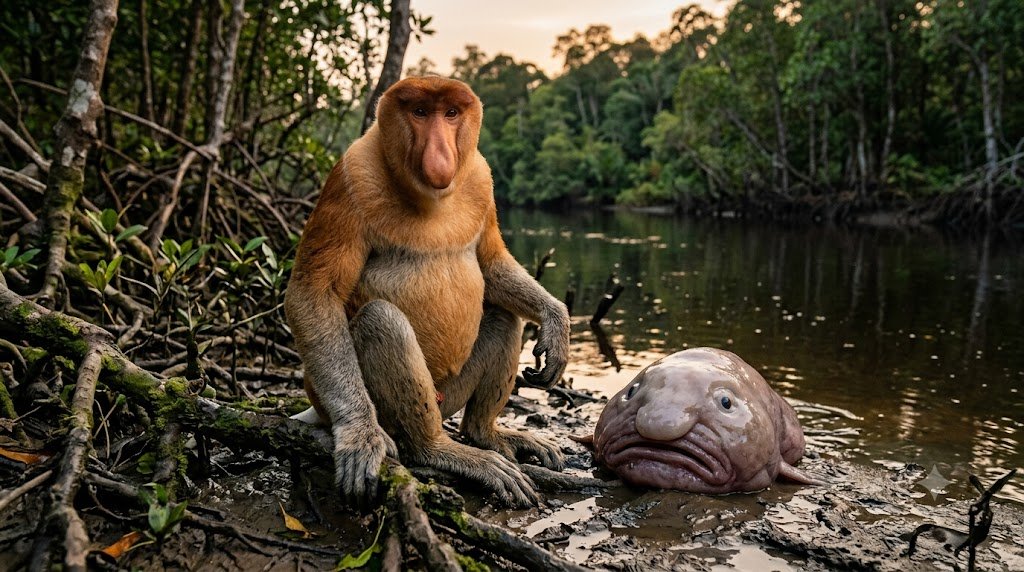
When we think about wild animals, our minds usually drift toward majestic lions, sleek cheetahs, or ridiculously adorable pandas. However, mother nature clearly has a wild sense of humor, and she certainly did not design every single living creature to win a beauty contest.
Across the globe, there exists a bizarre crew of quirky creatures that often get labeled as “ugly” by human standards. Yet, if you look past their unconventional faces and strange body shapes, you will quickly find some of the most remarkable evolutionary traits on planet Earth.
From deep-ocean squishy wonders to big-nosed tree dwellers, these unusual animals prove that beauty is truly skin-deep. Let us dive into the fascinating world of Earth’s most beautifully strange creatures and discover why they deserve our respect and admiration.
The Deep-Sea Royalty: Blobfish (Psychrolutes marcidus)
You cannot have a conversation about bizarre animals without giving a royal shout-out to the internet’s favorite sad face, the blobfish. Winning the infamous title of the “World’s Ugliest Animal” back in 2013, this jelly-like creature became an instant viral meme across social media platforms.
However, the blobfish gets a completely unfair reputation because of how we usually see it in photographs. In its natural habitat, nearly 4,000 feet deep beneath the ocean waves, the immense underwater pressure holds its body in a perfectly normal, surprisingly fish-like shape.
Because it lacks strong bones and dense muscle tissue, it floats effortlessly just above the ocean floor without expending precious energy. When pulled to the surface too quickly, the drastic drop in pressure causes its soft body to expand into a drooping, gelatinous blob.
The Big-Nosed Charm: Proboscis Monkey (Nasalis larvatus)
Heading straight into the lush, tropical rainforests of Borneo, we encounter another strangely charming creature known locally as the Bekantan. The proboscis monkey is instantly recognizable thanks to its extraordinarily large, pendulous nose that dangles over its mouth.
While a giant nose might seem like an awkward physical trait to us, in the monkey world, size truly matters. Male proboscis monkeys use their massive hooters as natural speakers to amplify their loud warning calls and, more importantly, to impress potential female mates.
Additionally, these impressive primates are incredible swimmers, possessing webbed feet and hands that help them cross dangerous jungle rivers inhabited by hungry crocodiles. Their strange look is paired with incredible survival skills that make them true jungle champions.
The Sci-Fi Nightmare: Aye-Aye (Daubentonia madagascariensis)
If you ever wandered through the dark forests of Madagascar at night, meeting an aye-aye might give you quite a sudden jump scare. With its large staring eyes, bat-like ears, and bushy tail, this unusual nocturnal lemur looks straight out of a Hollywood sci-fi movie.
What makes the aye-aye truly unique is its super-long, skinny middle finger, which looks almost like a dry tree twig. It uses this creepy digit to tap tap tap on tree trunks, listening carefully for hidden grubs chewing through the wood underneath the bark.
Once it detects a hollow spot with insects inside, it gnaws a tiny hole in the wood and uses that flexible finger like a hook to pull out its dinner. It is the world’s only primate that uses echolocation to hunt for food!
The Smiling Regeneration Master: Axolotl (Ambystoma mexicanum)
Unlike other animals on this list that lean heavily toward looking scary or droopy, the axolotl manages to be oddly cute despite its weird features. Native to the ancient lake complex of Xochimilco near Mexico City, this walking salamander retains its larval traits throughout its entire adult life.
With feather-like pink gills sticking out from its head and a permanent smiley face, the axolotl looks like a real-life Pokémon character. But its true magic lies beneath its smooth skin, hiding a medical superpower that completely fascinates modern scientists today.
If an axolotl loses a leg, a tail, or even parts of its heart and brain, it can regenerate them completely without leaving a single scar behind. Studying these little aquatic marvels could potentially unlock groundbreaking medical treatments for human healing in the near future.
The Digging Miracle: Star-Nosed Mole (Condylura cristata)
At first glance, the star-nosed mole looks like an alien creature that accidentally landed on our planet. Native to wet lowland areas in eastern North America, this small creature sports a ring of 22 fleshy pink tentacles bursting out from its snout.
Because it spends almost its entire life underground in pitch-black tunnels, vision is completely useless for this industrious digger. Instead, those 22 wriggling tentacles contain over 100,000 tiny nerve endings, making its nose one of the most sensitive touch organs in the entire animal kingdom.
It can touch, identify, and consume tiny aquatic insects in less than a quarter of a second, setting world speed records for animal foraging. What looks strange to human eyes is actually a high-tech navigation radar for living under the earth.
Why We Must Protect These Unconventional Creatures
It is easy for human beings to care about saving majestic tigers, graceful blue whales, or cute giant pandas. However, ecosystem health does not depend on physical attractiveness, and these weird-looking species play crucial roles in maintaining nature’s delicate balance across the globe.
Many of these animals, including the Bekantan in Indonesia and the Mexican axolotl, are currently facing severe threats from habitat destruction and pollution. Conservation efforts must extend beyond charming, photogenic animals to cover every unique link in the chain of life.
By shifting our perspective from “ugly” to “uniquely adapted,” we begin to appreciate the wonderful diversity that nature has created over millions of years. Every strange nose, squishy body, and extra-long finger tells a story of survival, resilience, and evolutionary brilliance.
Frequently Asked Questions (FAQ)
Why does the blobfish look so melted in famous photos?
The blobfish lives under extreme water pressure deep in the ocean. When brought to the surface by researchers or fishing nets, the sudden depressurization damages its soft tissues, causing it to collapse into a droopy, blob-like shape.
Is the Proboscis Monkey (Bekantan) an endangered species?
Yes, the proboscis monkey is currently listed as Endangered on the IUCN Red List. Their natural habitat in Borneo’s coastal mangroves and swamp forests is rapidly disappearing due to deforestation, palm oil plantations, and human development.
Can blobfish be kept as pets in home aquariums?
No, blobfish cannot survive in regular aquariums. They require extremely high water pressure and very low temperatures that exist only deep underwater in their natural ocean environment thousands of feet down.
Why do scientists study the Mexican axolotl so closely?
Scientists study axolotls because of their incredible ability to regenerate lost limbs, tail, spinal cord, and even internal organs. Understanding this process could help advance human regenerative medicine and organ repair techniques.